
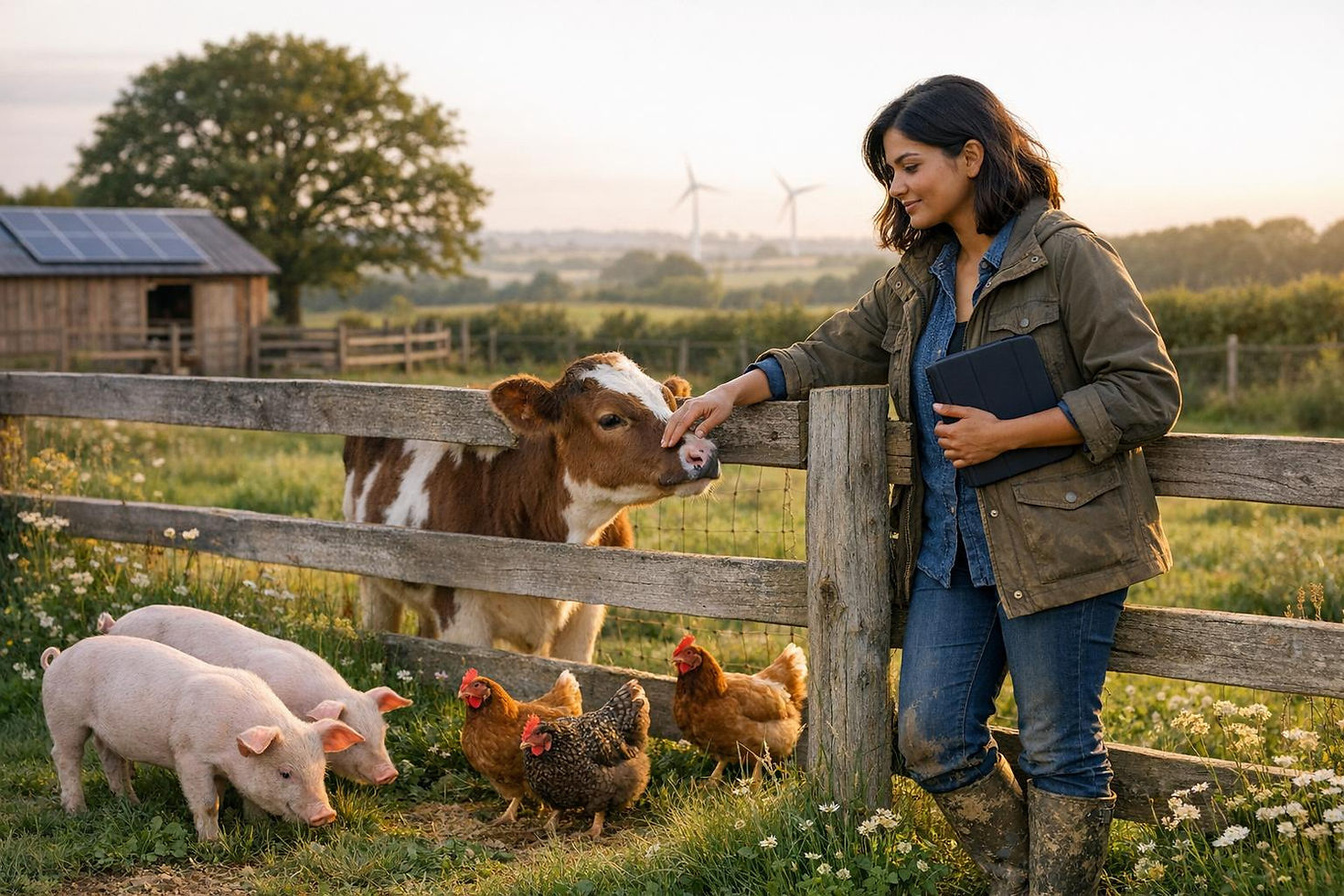
Cultivarian Ethics vs. Factory Farming

Over 70% of animals in the UK are raised on factory farms, which rely on confinement, rapid growth, and large-scale slaughter. By 2024, the UK had nearly 1,200 mega farms - a 20% rise since 2016. Factory farming prioritises efficiency but comes with severe animal welfare and environmental issues.
Cultivarianism offers an alternative: real meat grown from animal cells without slaughter. This approach minimises harm, respects animal dignity, and aligns with ethical concerns about animal sentience. Unlike factory farming, which treats animals as commodities, Cultivarianism views them as living donors, reducing suffering while addressing the demand for meat. It also uses science to cut greenhouse gas emissions and land use, presenting a more humane and sustainable option.
Key Differences:
Animal Welfare: Factory farming involves confinement, painful procedures, and slaughter. Cultivarianism eliminates slaughter and reduces suffering.
Environmental Impact: Cultivated meat uses fewer resources and emits less greenhouse gas than traditional farming.
Ethical Focus: Factory farming prioritises production; Cultivarianism prioritises compassion and science.
With over half of UK consumers open to trying cultivated meat, this shift could reshape how we produce and consume meat.
Cultivarian Ethics and Animal Welfare
Key Ethical Principles
At its core, Cultivarianism champions a simple yet profound belief: cultivated meat could end animal slaughter so that animals shouldn't have to die for humans to enjoy meat. This perspective is grounded in compassion - acknowledging the reality of animal suffering - and a commitment to honesty about the consequences of current practices. Philosopher Rosalind Hursthouse encapsulated this sentiment perfectly:
"The practices that bring cheap meat to our tables are cruel, so we shouldn't be party to them." [2]
Cultivarianism provides a practical, harm-reducing alternative for those who aren’t ready to give up meat entirely. It accepts minor compromises, such as using cell biopsies to gather starter cells, as a far lesser harm compared to the widespread killing involved in industrial farming. The vision is to shift animals from being seen as commodities to donors - valued as living sources of cells rather than as products destined for slaughter.
Animal Welfare in the UK
The UK has long grappled with the ethical treatment of animals, with significant public discussion around their sentience. The Animal Welfare (Sentience) Act 2022 officially recognised vertebrate animals as sentient - acknowledging their capacity to feel pain, fear, and distress. This legislation places a legal responsibility on government policies to consider animal welfare, creating a fertile ground for Cultivarian principles to resonate.
Cultivarianism fits seamlessly within this framework. If animals are sentient beings deserving of moral consideration, then the mass slaughter underpinning traditional meat production becomes increasingly difficult to justify. Cultivated meat offers a solution - producing meat while respecting the dignity of animals. This ethical approach stands in sharp contrast to the practices of factory farming, which prioritise efficiency over animal welfare.
Ethical Principles: Cultivarianism vs. Factory Farming
The ethical divide between Cultivarianism and factory farming is stark. Factory farming treats animals as mere tools for production, while Cultivarianism acknowledges their sentience and the importance of minimising their suffering. Andre Forgacs of Modern Meadow has pointed out that future generations are likely to view today’s industrial farming practices as deeply inhumane. [3]
Here’s a side-by-side comparison of these two approaches:
Ethical Principle | Cultivarianism | Factory Farming |
View of Animal Life | Sentient beings with dignity | Commodities for production |
Acceptable Meat Sources | Cultivated meat (no slaughter) | Slaughter-based meat |
Role of Technology | Innovation to reduce suffering | Efficiency-focused innovations |
Moral Status of Killing | Rejects slaughter | Accepts systematic slaughter |
sbb-itb-4eaa753
Factory Farming Practices in the UK
What Is Factory Farming?
Factory farming, or intensive animal agriculture, focuses on maximising the production of meat, dairy, and fish. This system keeps animals indoors throughout the year, often in crowded and controlled environments designed to prioritise efficiency. Animals are bred for fast growth and fed grain-based diets, which differ from their natural feeding habits. Everything from lighting to feeding schedules and breeding cycles is meticulously managed to boost productivity, often at the expense of animal welfare.
Animal Welfare Concerns
The focus on efficiency in factory farming comes with steep welfare costs. Beyond the obvious issue of overcrowding, animals are subjected to painful physical alterations. For instance, poultry often undergo beak trimming, while pigs experience tail docking to reduce aggression caused by cramped conditions. Practices like forced impregnation and separating young animals from their mothers also prevent natural behaviours like foraging and rooting.
"Factory farming treats animals as though they are meat factories rather than sentient beings." - PETA [1]
There’s also a public health angle to consider. Around 30% of antibiotics used in the UK are administered to farmed animals, which raises concerns about antibiotic resistance. Additionally, high stocking densities and genetic uniformity in these systems make it easier for zoonotic diseases to spread [1].
Welfare Issues by Species
The welfare challenges faced by animals in factory farming vary depending on the species. Below is a summary of typical conditions and key welfare concerns for some of the most commonly farmed animals in the UK:
Species | Typical Conditions | Key Welfare Issues |
Chickens | Broiler sheds, layer cages | Lameness, beak trimming, stress |
Pigs | Intensive pig units | Tail docking, confinement, boredom |
Cattle | Feedlots, intensive dairies | Limited mobility, stress |
Fish | Aquaculture systems | Overcrowding, poor water quality |
Farmed salmon, for example, pose a unique challenge due to their carnivorous diet, which requires large amounts of wild-caught fishmeal. This not only impacts the environment but also raises welfare concerns [1]. In dairy farming, the industry has increasingly focused on fewer cows producing higher milk yields, further intensifying production practices [5]. These species-specific issues highlight the ethical dilemmas inherent in factory farming, which will be explored further in relation to Cultivarian principles in the next sections.
Ethical Comparison: Cultivarianism vs. Factory Farming
Harm and Suffering
In factory farming, suffering is not incidental - it’s baked into the system. Confinement, painful procedures, and slaughter are part of the process, not unfortunate side effects. As an academic journal bluntly stated, industrial farm animal production "imposes significant and unnecessary harms that are known and can only be perpetuated because we, jointly, as a society, allow it to happen" [6].
Cultivarianism flips this approach entirely. It prioritises cruelty avoidance as a core principle rather than an afterthought. By growing meat from cells instead of raising and killing animals, it removes suffering from the equation. The process involves taking a small, low-impact cell sample, and even this step is designed to minimise any discomfort for the donor. Ethicists emphasise that this commitment to humane practices strengthens the Cultivarian ethos of plant-based and cultivated meat as ethical alternatives.
With this foundation in mind, let’s explore the moral considerations around killing in these systems.
Killing and the Moral Status of Animals
Factory farming treats animals as commodities, valuing them only for their utility. Their lives are controlled, shortened, and ultimately ended to maximise production.
Cultivarianism takes a completely different stance. Animals are no longer seen as products but as potential cell donors. The aim is to eliminate killing from the meat production process altogether. As researcher Steve Cooke puts it: "Cultivated meat wouldn't make meat-eating virtuous, but it would lessen its viciousness." [2].
This shift is particularly important for individuals who believe killing animals for food is wrong but struggle to act on that belief. Cultivarianism bridges this gap, offering a way to align dietary habits with ethical convictions. Ethicists call this dilemma "omnivore's akrasia" - the inner conflict of wanting to avoid harm while continuing to consume meat [2].
Technology and Science
In factory farming, technology serves a single purpose: efficiency. Practices like high-density feedlots, selective breeding, and widespread antibiotic use are all geared towards producing more meat for less money. These methods prioritise output over welfare. As one source highlights, factory farming focuses on "efficiency, or the amount of meat or milk produced, rather than other services and impacts such as environmental interaction, climate change, less antibiotic usage, animal welfare, or sustainability" [4].
Cultivarianism, on the other hand, uses science to address these very issues. By leveraging cellular agriculture, it drastically reduces greenhouse gas emissions and land use. Cultivated meat production is estimated to emit 78–96% fewer greenhouse gases and use up to 99% less land compared to traditional European meat production [4]. If cellular agriculture were fully adopted by 2050, it could cut annual food system greenhouse gas emissions by 52% [7]. These environmental benefits stem directly from Cultivarianism’s focus on replacing slaughter with science.
These contrasting uses of technology highlight the broader intergenerational ethics of meat production, as summarised below.
Ethical Dimensions Compared
Dimension | Cultivarianism | Factory Farming |
Animal Suffering | Eliminates suffering through science | Harm is integral to production |
Killing | Rejects slaughter | Systematic killing is required |
Resource Use | Ethical and efficient | High consumption of land, water, and feed |
Climate Impact | Lower emissions and land use | Significant environmental damage |
Cultivarianism and Food System Change
Cultivarianism's Place in Humane Food Systems
Factory farming has long been criticised for its ethical shortcomings, making it clear that rethinking how we source meat is essential. However, not everyone is ready to eliminate meat from their diets entirely, which leaves a gap in the conversation.
This is where Cultivarianism steps in. It doesn't conflict with other responsible food movements but instead carves out its own space. It appeals to meat-eaters who feel uneasy about animal slaughter but haven't yet found a viable alternative. As the Journal of Agricultural and Environmental Ethics explains:
"Even if virtuous people wouldn't eat cultivated meat, they may welcome it as part of the path towards a compassionate world." [2]
In the UK, the current food system offers little room for compromise. Consider this: around 50% of UK land is dedicated to livestock, yet the country still produces only about 60% of the food it consumes [8]. This imbalance highlights the strain on the system, creating an opening for alternative approaches like Cultivarianism to gain traction. It’s a step towards reshaping how we think about meat consumption.
A New Path for Meat Consumption
Cultivarianism offers a shift in meat production without demanding people give up meat entirely. The Cultivarian Society was established on this very principle: that individuals can reject slaughter-based meat production while continuing to eat real meat. It provides a distinct identity, separate from veganism or vegetarianism.
For many, the attachment to meat is deeply ingrained, making the idea of giving it up entirely a tough ask. Cultivarianism bridges this gap by addressing the ethical dilemma directly. Instead of forcing people to choose between their dietary habits and their values, it provides a production method that aligns with both.
The facilities used for cultivated meat production underscore this shift. Chris Macdonald, a Fellow at the University of Cambridge, describes them as:
"Rather than resembling factory farms or slaughterhouses, these facilities look like breweries, with rows of stainless-steel tanks where microbes or animal cells convert simple nutrients into proteins." [8]
This imagery alone highlights how different the approach is from traditional meat production.
Food System Approaches Compared
To better understand Cultivarianism, it helps to compare it with other food systems. Each approach reflects distinct ethical priorities and production methods:
Approach | Role of Animals | Ethical Aim | Relationship to Meat |
Factory Farming | Commodities for production | Focused on profit and efficiency | Relies on slaughter |
Cultivarianism | No slaughter involved | Compassionate and science-based | Supports cultivated meat |
Sustainable Models | Integrated with ecosystems | Balances ethics and ecology | Reduces dependence on livestock |
Factory farming prioritises volume and cost above all else. Sustainable models aim to minimise harm while still using livestock. Cultivarianism, however, takes a bold step by eliminating slaughter entirely. It’s this distinction that sets it apart, offering a fresh perspective in the ongoing discussion about transforming food systems.
Why Lab Grown Meat Could Change Everything or Not.
Conclusion
Cultivarianism and factory farming stand at opposite ends of the spectrum when it comes to meat production. Factory farming focuses on treating animals as products, prioritising efficiency and cost over everything else. In contrast, Cultivarianism is built on a simple but powerful principle: unnecessary suffering is wrong, and meat production doesn’t have to involve slaughter. This core difference reflects a broader transformation in how meat can be produced.
These ethical divides are also starting to influence consumer behaviour. For instance, a 2025/2026 survey of 600 UK respondents revealed that 53.8% were open to trying cultivated meat [9]. This statistic highlights a growing curiosity and willingness among consumers to explore alternatives.
The movement has gained momentum through organisations like The Cultivarian Society, which has provided a name, a community, and a clear identity for this shift. Embracing Cultivarianism means rejecting the idea that slaughter is a necessary cost for meat, without rejecting meat itself. It’s a decision rooted in compassion and transparency, offering a forward-thinking alternative alongside other dietary choices. This shift also addresses broader issues of food justice and equality within the UK food system.
As Steve Cooke aptly put it, "Cultivated meat wouldn't make meat-eating virtuous, but it would lessen its viciousness" [2]. This sentiment captures the essence of Cultivarianism’s mission: to pave the way for a more humane and ethical food system.
FAQs
How is cultivated meat actually made?
Cultivated meat is produced by growing animal cells in a lab, bypassing the need to raise and slaughter animals. The process begins with a small sample of animal cells, which are placed on edible scaffolds. These cells are then nourished with a nutrient-rich culture medium inside bioreactors. These bioreactors replicate the conditions found within an animal's body, enabling the cells to grow and develop into muscle tissue. This method creates genuine meat, eliminating animal slaughter and lessening the strain on the environment.
Does cultivated meat involve hurting animals at all?
Cultivated meat offers a way to produce real meat without causing harm to animals. Instead of traditional farming methods, it involves growing animal cells in carefully managed environments, such as bioreactors. This approach removes the need for slaughter while still delivering authentic meat.
When will cultivated meat be available in the UK?
Cultivated meat could hit UK shelves within the next five years, pending successful safety assessments and regulatory approval. Projections indicate that these evaluations might wrap up by early 2027.


Comments